











Pakistan’s accusation that Mountbatten and the British government conspired to ensure that Kashmir went to India rests on the assumption that the British had strategic interests in Asia that they would need to safeguard even after leaving India, and that, in their considered judgment, India would be a much more reliable and effective guardian of these interests than Pakistan.
In his book, Kashmir: A Disputed Legacy, Alastair Lamb identified the strategic purpose to be the monitoring of Soviet activities in Central Asia with a view to checking Soviet expansion in a southerly direction. For this, keeping tabs on Sinkiang was essential, and that could be done only from the northernmost parts of Kashmir – ie, Gilgit and Hunza. Lamb based his conclusion that the British had conspired with India over Kashmir almost entirely on Mountbatten’s decision to retrocede Gilgit and Hunza to the Maharaja of Kashmir in 1947, instead of transferring the 60-year lease of the area signed with Maharaja Hari Singh to Pakistan, which, he believes, would have been in accordance with the principles of Partition laid down in the India Independence Act.
Pakistan first made this accusation before the UN Security Council in January 1948, when it was defending itself against India’s charge of aggression in Kashmir. The charge had no substance even then, for, as is shown later, British interests – and the role Britain played in the Kashmir dispute – were the exact opposite of the one Pakistan accused it of playing.
No one would deny that in the early 1930s, British strategists had a lively interest in keeping a weather eye on Sinkiang. Czarist Russia had been swept away by the Bolsheviks a decade and a half earlier, and the USSR had the makings of a stronger and more dangerous adversary in Central Asia. Sinkiang, and a narrow strip of Afghanistan, were all that separated the Soviet Union from British India. Sinkiang, then barely under the control of the Chinese government in Beijing, had become a hotbed of Soviet intrigue. Thus, whether or not Sir Olaf Caroe really had vol. xiv of Aitchison’s Treaties replaced in order to use the threat of entering into bilateral agreements with Sinkiang to soften the Chinese (as they had used their agreements with Tibet in 1914), this would certainly have been a useful strategy to adopt.
However, Britain’s interest in Sinkiang was a pale shadow of its obsession with Afghanistan. Although Afghanistan by itself was small, weak, and of little account, the Afghans were ethnically linked to the Pathans of the tribal area on the Indian side of the Durand Line. And the Pathans were a constant source of worry, for at any one time there were 300,000 or more tribesmen who could pick up the gun and set out to raid the settled areas to the south. The Afghans had the capacity to incite the Pathan tribes; so if Afghanistan came under Soviet influence, the USSR would get a powerful lever with which to destabilise the Indian empire.
This fear was not of recent origin. It originated not in the 1930s but 130 years earlier – to be precise, when Napoleon invaded Egypt. Ever since then, the overriding British preoccupation was to safeguard the north-western marches into India. Afghanistan came into sharp focus in 1810, when two British officers, Charles Christie and Henry Pottinger, set out from Kalat in Baluchistan to reconnoitre two possible routes that the Russians might use to invade India.
From the early 1900s, as the Manchu dynasty fell and a new Chinese army emerged and began to flex its muscles in Tibet, the British also began to take steps to safeguard their northern borders. But, as the Earl of Birkenhead was to say in 1926, this remained a subordinate concern and disappeared altogether in 1947, when the British left India. After 1947, they perceived their strategic interests in the region very differently after they decided to leave India, from the way they had perceived them at the heyday of their power. Far from being obsessed with China, they became more concerned with preventing the southward expansion of the Soviet Union towards the Persian Gulf, for that would have gravely endangered their vital oil interests in Iran and Iraq, and their possessions in Kuwait and the Trucial States. An equally important concern was the safety of their possessions in the Far East, notably Singapore, Malaya, and Hong Kong.
A united India would have been pivotal for securing both. But once it became clear that Partition could not be avoided, Pakistan – and not India – became the sheet anchor for British strategic and economic interests in Asia. This was a crucial element in their attitude towards the Muslim League, towards the Khudai Khidmatgars (Servants of God) government of the Khan brothers in the North West Frontier Province, and inevitably, towards Kashmir.
Lamb’s attempt to revive, more than forty years later, the thesis that British actions in 1947 were guided by fear of pressure on India’s Himalayan borders is therefore surprising, to say the least. To do so he overlooked the rather obvious fact that the Indian strategic concerns of 1947 were not the same as the British concerns of the early “Thirties”. Once India was partitioned, the Himalayas ceased to be the country’s natural ramparts in the north. With the creation of Pakistan, the enemy – metaphorically speaking – had breached the fortifications and was digging its trenches across the main courtyard. Kashgar, Sinkiang, and Lhasa – the names that generations of British strategists at the India Office juggled with, faded rapidly from the Indian consciousness.
This may have been one of the reasons why, other than Nehru, very few in the Congress showed any interest in, or indeed enthusiasm for, securing Kashmir’s accession. In fact, with the enemy ensconced in the courtyard, the enemy’s neighbour became one’s friend. This explains, at least partly, Pandit Jawaharlal Nehru’s ready acceptance of China’s assertion (or reassertion) of sovereignty over Tibet in 1950, and his subsequent friendliness towards the Soviet Union.
In the 1920s, the British had good reason to fear the Afghans. Afghanistan had never become reconciled to Britain’s separation of the belt of land, called the “Independent Tribal Territories”, that fell east of the Durand Line and west of what the British called the “Administrative Border” of the NWFP. The purpose of this strip of land was to create a buffer zone between Afghanistan and British India.
In 1919, Habibullah Khan, the Amir of Afghanistan, had been assassinated and succeeded by Amanullah Khan. While Habibullah had been friendly to the British and had accepted the Durand Line, Amanullah had other ideas. Taking advantage of a wave of nationalist unrest in India, he sent his troops into the Administered Territories and began to incite the tribes of the area into a holy war against the British. This led to the Third Afghan War, in which the much modernised Afghan army initially achieved a fair measure of success. Only massive reinforcement of the troops on the border – and the first-ever use of the Air Force in an Afghan war – enabled the British to turn the tables.
This experience was still fresh in the minds of the British when the Secretary of State for India, the Earl of Birkenhead, gave a memorable lecture to the ninth meeting of the Imperial Defence Council on October 26, 1926:
In the future the North Eastern Frontier where it marches with China, may also come into prominence, but at present it causes no anxiety. The potential enemy on the North West Frontier is, of course, Afghanistan, acting alone or as the ally or instrument of Bolshevik Russia. The policy initiated by Peter the Great of penetrating to the warm water has not changed with changing forms of government – rather, so far as an advance towards India is concerned, it has received an added incentive from the desire to weaken the great obstacle to the extension of Bolshevik tenets which is represented by the British Commonwealth of Nations. The fanatical and warlike inhabitants on and across the North West Frontier of lndia form an ideal weapon for the purpose; the simple peasantry of India are a fertile soil for propaganda…We have to be prepared to meet Russain aggression cowards India in a new and far more dangerous form…Between the administrative boundary of India and the frontier of Afghanistan, known as the Durand Line, lies a belt of the most difficult country inhabited by tribes that could put into the field some 300,000 first-class fighting men, adequately armed. They have always formed the Afghans’ most potent weapon against us…
John Foster Dulles would have been proud to have given such a speech. But the most significant part was yet to come. Birkenhead drew attention to the “new factor introduced by aircraft”, bringing with it the need for anti-aircraft protection. At Kabul, he noted, there was a small, Russia-trained Afghan Air Force – “not actually formidable on its material side but with great possibilities for harm in its moral effect”. Further, the existence of landing grounds in Afghanistan gave the Russians the power of placing considerable air forces at very short notice within striking distance of the plains of India.
More than anything else, it was this fundamental shift in the art of war that was to determine the fate of the subcontinent for the next seventy years. It led to a revival of the Palmerstonian Forward Policy with a vigour that few could have predicted. With Imperial Russia, the British had had diplomatic relations and a host of pressure points; with the Soviet Union, they had virtually none. And while Czarist Russia had been a month’s hard march away across hostile terrain, the USSR was now a matter of hours by air.
For the next 20 years, both these factors grew steadily stronger. After the war, Britain was exhausted but the USSR seemed vastly strengthened. And the air force had become the lethal spearhead of modern warfare.
When the British made up their minds to leave India, the forward policy lost much of its relevance for Britain as a global hegemon – but it retained relevance for the Western democratic alliance against Communism, of which Britain now formed a part. Prime Minister Attlee’s letter of instructions to Mountbatten, when sending him to India, made this abundantly clear. After spelling out the administrative and political steps required if Partition became unavoidable, Attlee concluded:
You should take every opportunity of stressing the importance of ensuring that the transfer of power is effected with full regard to the defence requirements of India. In the first place you will impress upon the Indian leaders the great importance of avoiding any breach in the continuity of the Indian Army and of maintaining the organisation of defence on an all-India basis. Secondly, you will point out the need for continued collaboration in the security of the Indian Ocean area…
Attlee’s instructions were based on a note prepared for the Cabinet by the British Defence Council in early 1946. British strategic interests in ‘the Indian Ocean and neighbouring areas’ would be served, the note said, if the treaty with the successor government allowed Britain “to move formations and units, particularly air units, into India at short notice”. It recommended that the government attempt to keep some British personnel on in India. But it added a warning: if withdrawal were to include all British personnel, including those in the service of the Indian government, the fulfilment of Britain’s strategic requirements would be improbable.
The note thus indicated a shift of focus in Britain’s strategic priorities. The subcontinent would henceforth be important mainly as a base from which to guard wider strategic interests. The Labour government believed that leaving behind a strong, united India, friendly to Britain and willing to allow key British personnel to continue serving in the armed forces, would be the best way to meet this need.
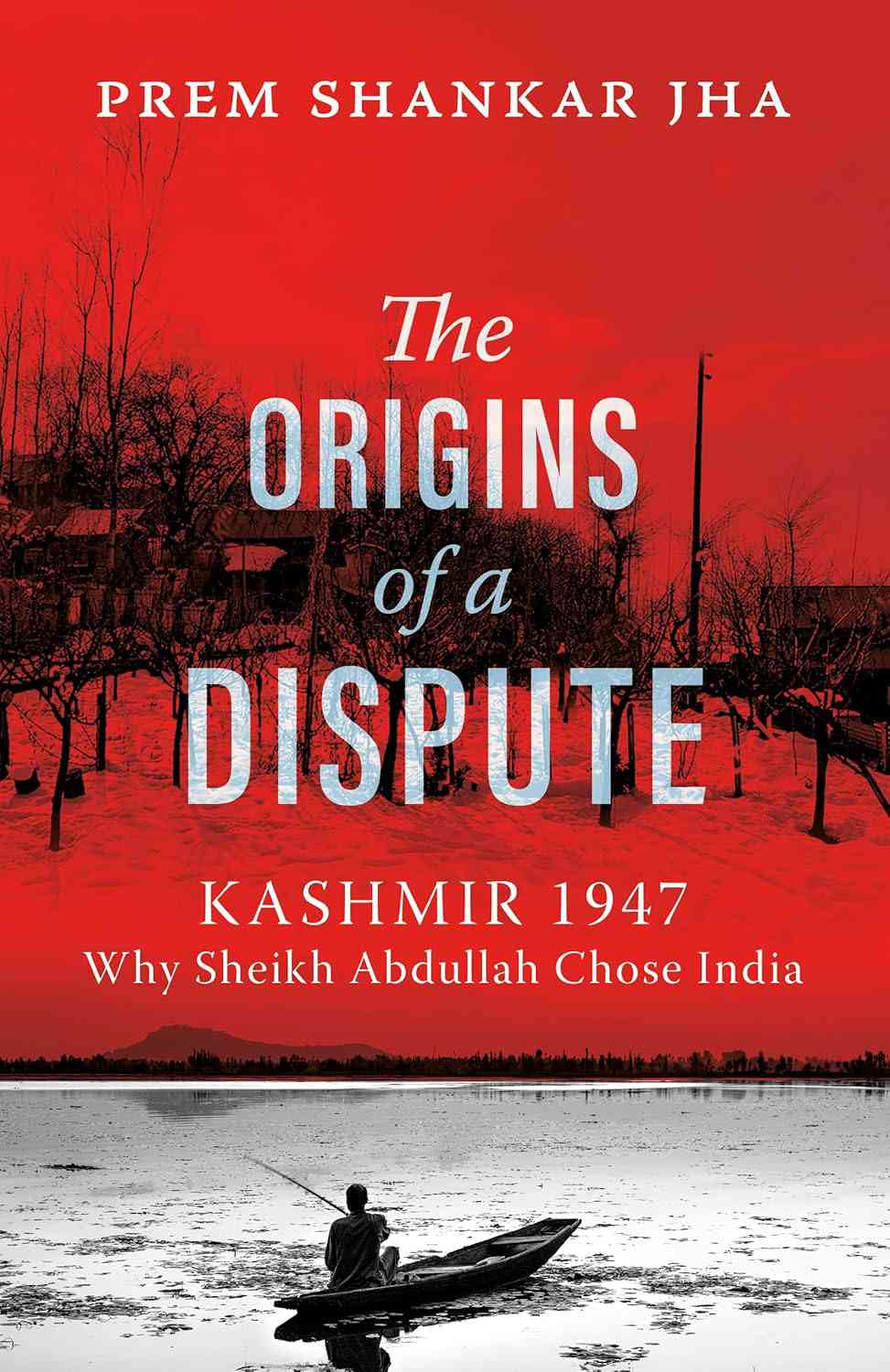
Excerpted with permission from The Origins of a Dispute, Kashmir 1947: Why Sheikh Abdullah Chose India, Prem Shankar Jha, Speaking Tiger Books.
